OPTICAL PHYSICS & ATMOSPHERE
WHEN THE SKY CHANGES
In polar latitudes, the atmosphere does not act as a neutral window. Extreme thermal stratifications, diamond dust ice crystals, and solar-terrestrial magnetic coupling create visual events that have confounded human navigation for centuries.
MAGNETOSPHERIC MECHANICS
THE AURORA BOREALIS: EMISSION OVER REFLECTION
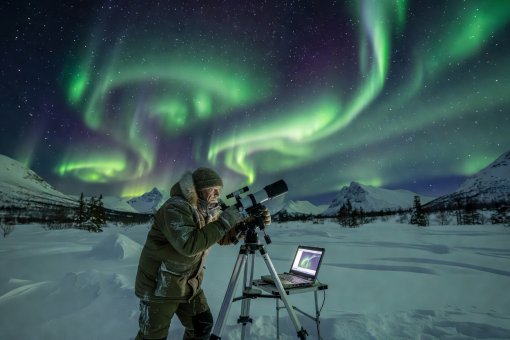
Unlike rainbows or halos, auroras are not caused by sunlight reflecting off water or ice. They are direct emission phenomena. Charged solar particles (protons and electrons) guided by Earth's magnetic field strike neutral gas atoms in the upper ionosphere.
Oxygen atoms hit at 100 to 150 kilometres emit the familiar luminous green (557.7 nm wavelength). Rare, high-altitude collisions above 200 kilometres release deep crimson red (630.0 nm), while ionized molecular nitrogen produces purple fringes along the lower borders of fast-moving curtains.
557.7 NM
Green Oxygen Line Emission
22° ARC
Standard Hexagonal Ice Crystal Halo
1597
First Log of Novaya Zemlya Mirage
2.5°+
Apparent Elevation Shift in Thermal Inversion
FOUR EXTRAORDINARY POLAR SKY PHENOMENA
 REFRACTION DUCTING
THE NOVAYA ZEMLYA EFFECT
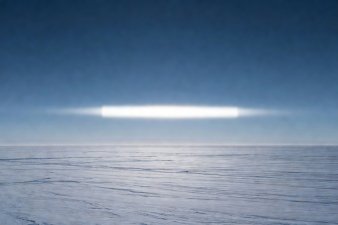
Documented in January 1597 by Willem Barentsz's stranded crew, the sun was seen rising two full weeks before its calculated return after polar night. An atmospheric duct caused by steep inversion bent rays over hundreds of kilometres of Earth's curved rim.
 CRYSTAL REFLECTION
PARHELIA & 22° HALOS
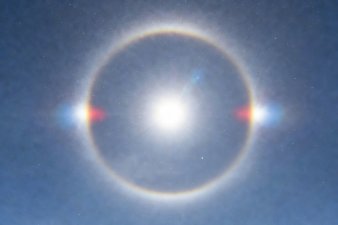
Commonly known as "sun dogs," parhelia appear when microscopic hexagonal ice plates flutter horizontally through calm cold air. Light entering a side face and exiting an alternate face refracts by exactly 22 degrees, forming mock sun pairs.
 VERTICAL SPECULAR
SOLAR PILLARS
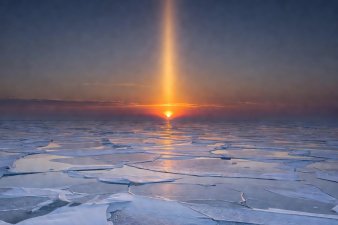
When the sun sits close to the horizon, plate-shaped ice crystals suspended in sub-zero calm air tilt slightly while drifting downwards. Their flat faces act as microscopic mirrors, directing a vertical shaft of light straight up into the stratosphere.
 NAVIGATIONAL SKY MAP
ICE BLINK & WATER SKY
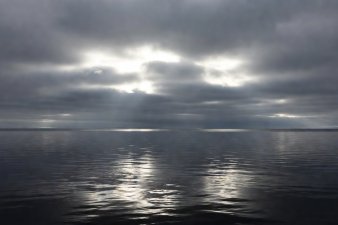
Indigenous Arctic travelers and early whalers mapped unseen terrain over the horizon by observing the cloud undersides: bright whitish glare indicates ice sheets below, whereas charcoal-dark patches ("water sky") reveal navigable open leads.
DISSECTING OPTICAL MISCONCEPTIONS
Observation: "The Northern Lights are burning clouds."
Explanation: Weather clouds sit in the troposphere (under 12 km altitude). Auroras take place in the ionosphere and thermosphere between 90 and 400 kilometres above ground. Auroral curtains pass unimpeded above cloud cover and are entirely separate from atmospheric water droplets.
Observation: "I saw an island floating in the sky upside down."
Explanation: This is a classic superior mirage or Fata Morgana. When sea ice chills the bottom layer of air to temperatures far colder than the air a few dozen metres above, an inversion gradient forms. Light bends concave-downward toward the ground, presenting an inverted image floating above an upright one.
Observation: "The aurora crackles like dry brush."
Explanation: Human ears cannot hear sound emitted 100 km high through near-vacuum space. However, during intense geomagnetic events, electrical charges accumulated on inversion layers close to the surface (70 m) produce miniature electrostatic discharges, which observers hear as faint clicking or clapping sounds.
FIELD NOTE SUMMARY
Arctic sky phenomena are never arbitrary; they are accurate visual barometers of temperature inversion depth, solar coronal mass ejections, and crystal morphology in the lowest kilometre of the polar troposphere.
CONTINUE TO SEA ICE DYNAMICS