CRYOSPHERE MECHANICS
A SEA THAT BECOMES LAND
Sea ice is not simply frozen lake water on a wider scale. It is a porous, living mineral structure that breathes salt, flexes under storm swells, and alters ocean circulation around the entire globe through thermohaline downwelling.
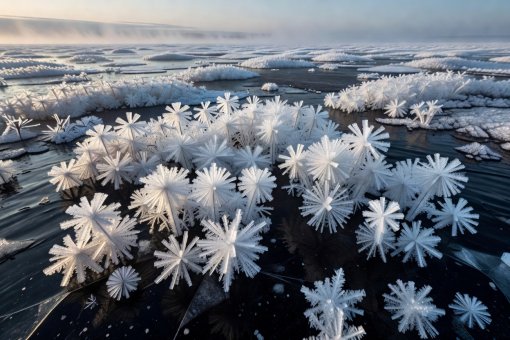
MICRO-CRYSTAL PHENOMENON
FROST FLOWERS: SALINE BLOSSOMS ON THIN PACK
In early winter, when sea ice first solidifies into a thin rind known as nilas, a severe temperature gradient exists between the -1.8 °C seawater below and the -25 °C air above. Moisture rising through micro-fissures flash-freezes into delicate structures called frost flowers.
These spiky crystals pull concentrated brine from the surface of the new ice, reaching salinities up to three times that of standard seawater (up to 100 parts per thousand). Remarkably, each blossom hosts dense colonies of halophilic psychrophilic bacteria flourishing within extreme salt concentrations.
35 PPT
Average Ocean Salinity
< 2 PPT
Salinity of Multi-Year Arctic Ice
10–25 M
Underwater Keel Depth on Pressure Ridges
2–3 CM/DAY
Average Beaufort Gyre Ice Drift Velocity
THE LIFE CYCLE OF ARCTIC SEA ICE
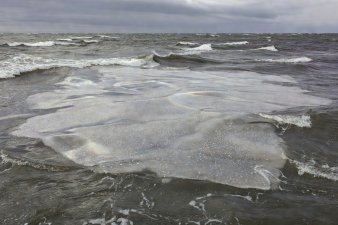 STAGE 1: EMBRYONIC ICE
FRAZIL & GREASE ICE
When calm sea water chills to -1.8 °C, microscopic disk-shaped crystals called frazil form. In rough winds, they coalesce into an oily surface layer that dampens waves, known technically as grease ice.
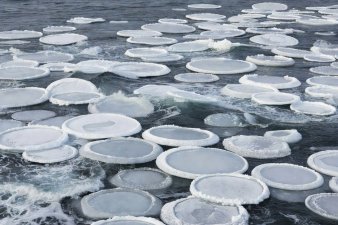 STAGE 2: WAVE ACTION
PANCAKE ICE FORMATIONS
Under continuing wave motion, grease ice breaks into circular plates ranging from 30 centimetres to 3 metres wide. Their constant collisions build raised rims of compressed slush along every margin.
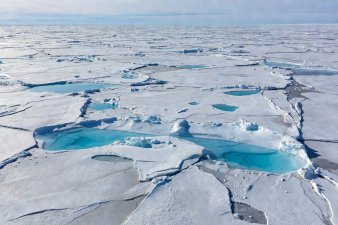 STAGE 3: CONSOLIDATION
FAST ICE & PRESSURE RIDGES
As winter intensifies, floes cement together. When ocean winds drive opposing sheets together, they buckle upward into pressure ridges and downward into submarine "keels" up to 25 metres deep.
 STAGE 4: THE ANOMALY
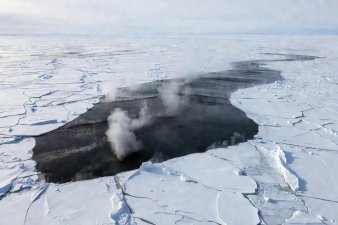
POLYNYAS & CRYOSPHERIC OPENINGS
Polynyas are vast areas of persistent open water where thick pack ice should normally form. Driven by persistent katabatic winds or upwelling warm deep currents, they serve as vital winter biological oases.
MECHANICS: HOW BRINE IS EXPELLED
Water molecules can only form regular hexagonal ice lattices when foreign ions like sodium (Na⁺) and chloride (Cl⁻) are excluded. As seawater freezes, the salt is rejected into liquid pockets called brine pockets.
Because these pockets remain liquid at temperatures far below zero, they are heavier than the surrounding solid ice. Driven by gravity and density gradients, they slowly migrate downward over months, carving microscopic vertical chimneys called brine drainage channels. By the time a floe survives two or three summer melting cycles, almost all salt has drained out into the ocean below, leaving behind buoyant, hard, low-salinity freshwater ice.
FIELD NOTE SUMMARY
Sea ice is neither static nor sterile. It is a constantly shifting mechanical plate that insulates the polar atmosphere from ocean heat and powers planetary ocean convection through brine rejection.
EXPLORE FAR ARCTIC ISLANDS