PHYSIOLOGY & EVOLUTION
LIFE AT THE LIMIT
In conditions that would rapidly destroy unadapted mammalian cells, Arctic organisms thrive through physiological mechanics that rival laboratory bioengineering. Rather than merely enduring the cold, these species have adapted their cellular chemistry to require it.
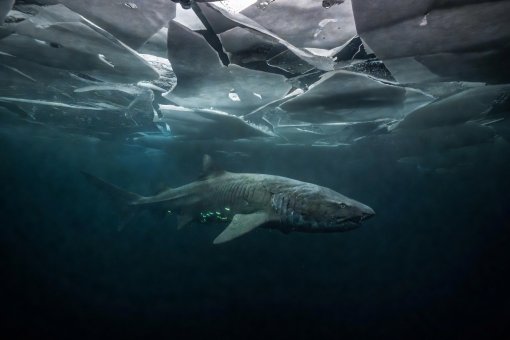
CENTURIES IN SUB-ZERO WATER
THE GREENLAND SHARK: FOUR CENTURIES OF METABOLIC SLOWNESS
Inhabiting depths from the surface down to 2,200 metres across the North Atlantic and Arctic basins, Somniosus microcephalus is Earth's longest-living vertebrate. Radiocarbon dating of eye lens proteins published by Danish biologists in 2016 established life spans reaching 392 ± 120 years.
They do not reach sexual maturity until approximately 150 years of age. Their muscle tissues are saturated with high concentrations of trimethylamine N-oxide (TMAO) and urea, which act as natural baroprotectants and cryoprotectants, preventing proteins from distorting under high pressures and freezing temperatures.
390+ YRS
Estimated Greenland Shark Lifespan
-16 °C
Sub-Zero Survival Limit for Arctic Wood Frogs
71,000 KM
Annual Arctic Tern Round-Trip Migration
0.05 MM
Typical Diameters of Ice-Algae Colonies
SPECIALIZED SURVIVAL STRATEGIES
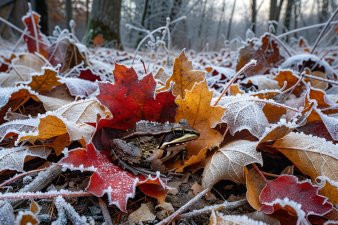 CRYOPROTECTIVE GLUCOSE
THE CRYOGENIC WOOD FROG
The Arctic wood frog (Lithobates sylvaticus) survives northern winters with up to 65% of its body water frozen into extracellular ice. Its liver produces massive surges of glucose and urea, packing cells to prevent internal freezing while its heart stops beating completely for months.
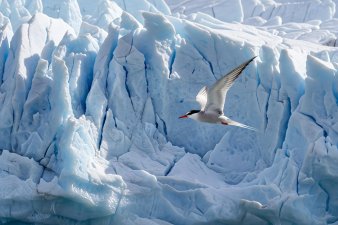 GLOBAL MIGRATION
THE PERPETUAL DAYLIGHT BIRD
The Arctic tern (Sterna paradisaea) breeds in the high Arctic tundra and winters along the edge of Antarctic pack ice. By migrating from pole to pole each year, it experiences more continuous daylight than any other living creature on Earth.
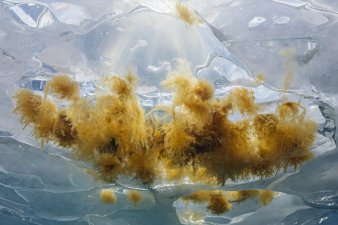 BASE OF THE FOOD CHAIN
SYMPAGIC ICE ALGAE
Attached to the submerged underside of sea ice floes, diatoms and sympagic algae synthesize specialized antifreeze proteins that prevent crystal growth within their membranes. They form the primary food source supporting Arctic krill, cod, seals, and apex predators.
 THERMAL INSULATION
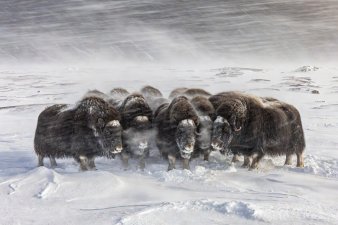
THE ANCIENT MUSKOX
Muskoxen survive -40 °C winds thanks to qiviut, an underwool eight times warmer than sheep's wool and finer than cashmere. Rather than building fat layers like marine mammals, they rely on this dense fiber shield to minimize heat loss.
HOW ANTIFREEZE GLYCOPROTEINS FUNCTION
For polar marine teleost fish (such as polar cod, Boreogadus saida), freezing is an immediate danger: the surrounding ocean remains liquid at -1.8 °C due to salt, while ordinary teleost blood freezes at around -0.9 °C.
To survive, these fish synthesize antifreeze glycoproteins (AFGPs). Rather than lowering the freezing point through bulk osmotic pressure, these specialized molecules bind directly to developing ice crystal planes, halting crystal expansion through the Kelvin-Helmholtz effect. This suppresses the freezing point of body fluids by approximately 1.5 °C without affecting the melting point, creating a stable thermal hysteresis gap that keeps them alive in ice-choked waters.
FIELD NOTE SUMMARY
Polar life demonstrates that extreme conditions drive evolutionary specialization. Far from barren, the high Arctic represents a finely balanced biosphere shaped by sub-zero physics.
READ FREQUENTLY ASKED QUESTIONS